TLDR: That shaky, starving, raid-the-cupboards feeling after a long day of cycling gets called a “sugar crash”, but in my experience it’s almost always underfuelling: not enough carbohydrate before and during the ride, and too long a gap before you eat afterwards. The fix is to set an hourly carb target for the ride, pack more food than you think you’ll need, and have a recovery snack or meal ready for when you get in.
My first club ride: how I learned this the hard way
I’ve been a nutritionist for a long time, so you’d think I’d be immune to this. I’m not.
When I first got into cycling and triathlon, I knew plenty about fuelling but very little about how club rides work. My first one was billed as an easy 36 to 40 km. I turned up on a bike I’d bought off Facebook Marketplace about ten years earlier. The front derailleur had been broken since the day I got it, and the screws had sheared off on top, so I couldn’t even replace it. That meant I was stuck in the big ring for the whole ride, so the more tired I got, the less gears I had to do anything about it. Around me were people on £5,000 to £10,000 bikes. They were, of course, the type to tell you it’s the rider, not the bike, that makes the difference, despite the fact that you absolutely can just buy speed.
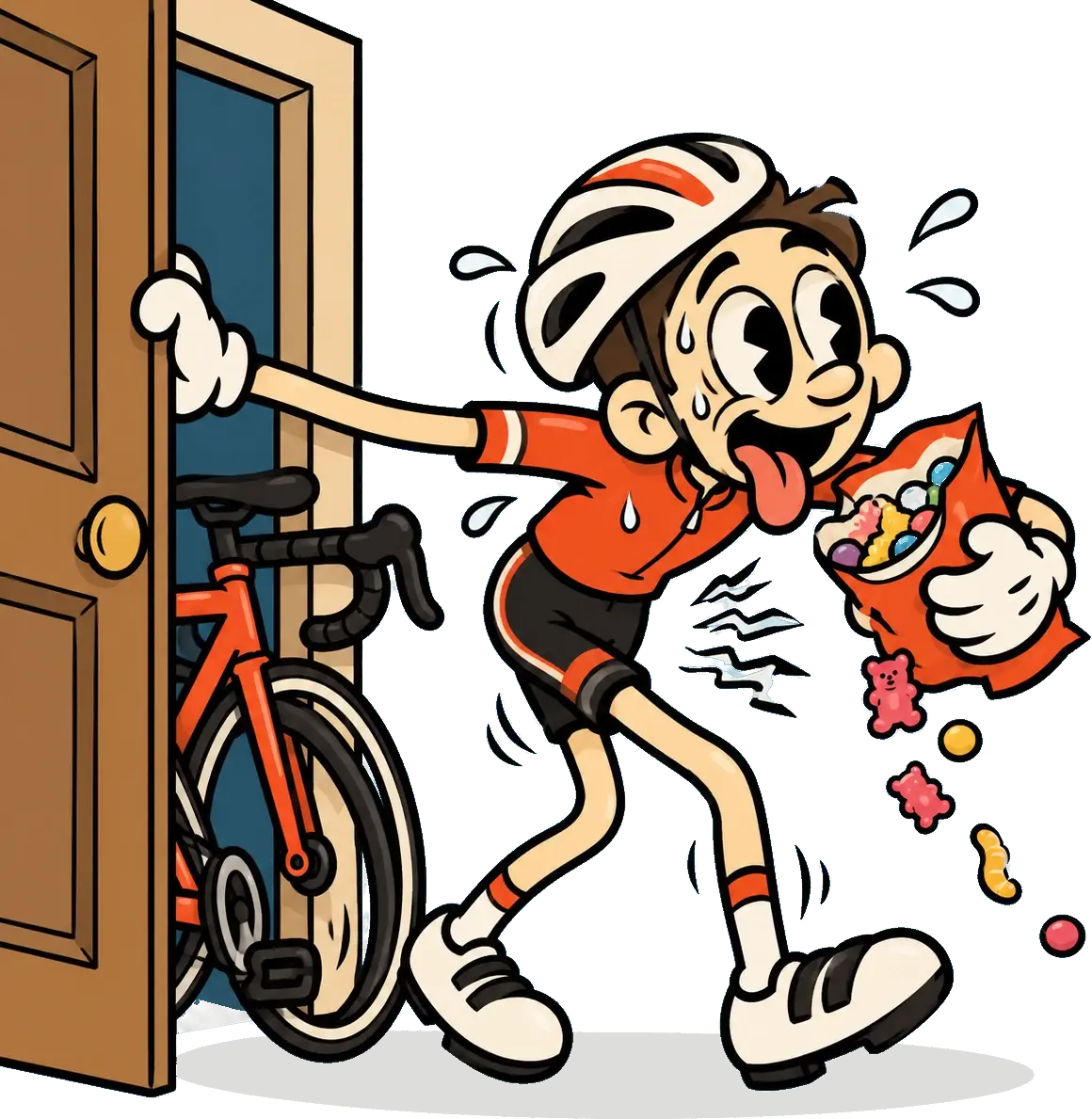
The “easy 36 km” turned into almost 80 km of me white-knuckling it, just trying to hold on to someone’s wheel. I stumbled through the front door, tore open the first bag of Haribo and had finished it before I’d got my shoes off. The second bag went the same way, followed by a full lunch. My girlfriend watched the whole thing, somewhere between amazed and horrified. I was a broken man.
Never again. The description of a club ride and what it actually turns into can be very different things. These days I take out far more fuel than I need and usually come home with a few gels or bits of food still in my pocket.
What’s actually happening when you bonk?
To understand the slump, it helps to know where your energy comes from on the bike. Think of it as two fuel tanks and one big reserve.
- Muscle glycogen: carbohydrate stored in your leg muscles. It’s the main fuel for riding at any decent pace, and only those muscles can use it.
- Liver glycogen: a much smaller store in your liver. Its job is to keep your blood sugar steady, which matters because your brain runs mainly on glucose.
- Fat: a huge reserve, even in very lean riders. But your body can only turn fat into energy relatively slowly, so on its own it’s not great at sustaining hard efforts.
Your carbohydrate tanks are small compared with what a long ride can burn (Gonzalez et al., 2016). Scientists have known since the 1960s that how much glycogen you start with largely decides how long you can keep going at a solid effort (Bergström et al., 1967). If you don’t top them up as you ride, they run low, and that happens in two ways.
Your legs run low
As muscle glycogen falls, your body leans more and more on fat. Because fat is a slower fuel, you simply can’t hold the same power. That’s the “legs suddenly empty” feeling: the pace you could hold an hour ago now feels impossible.
Your brain runs low
As your liver store empties, it can’t keep up with how fast your muscles are pulling sugar out of your blood, so your blood sugar starts to drop. Your brain, unsurprisingly, is not a massive fan of this. That’s where the shakiness, the fog, the irritability, the tunnel vision and the odd emotional wobble come from. In one study, cyclists who rode for three hours without carbohydrate saw their blood sugar fall, and their brain’s drive to their muscles dropped with it. Those given glucose didn’t have that drop (Nybo, 2003).
The good news is that carbohydrate on the bike works. In a classic study, trained cyclists riding hard with only flavoured water hit exhaustion at about three hours, just after their blood sugar dropped. When they took carbohydrate, their blood sugar held steady and they kept going for about another hour (Coyle et al., 1986). In a follow-up study, cyclists who’d already ridden to exhaustion were given carbohydrate. Their blood sugar rose and they were able to carry on for longer than when they were given a placebo (Coggan & Coyle, 1987). Eating late helps, but it’s far better not to get there in the first place.
Why it hits hardest once you’re home
Often you get away with it on the bike, especially on the last stretch home when adrenaline and the thought of the sofa carry you. Then you stop. Your muscles and liver are low on stored carbohydrate and keen to refill, your blood sugar may already be on the low side, and your body sends out a loud, urgent signal to eat everything you can get your hands on, like an especially grumpy grizzly bear coming fresh out of hibernation. That’s the shaky, starving, eat-anything feeling. It’s your body asking for the fuel it didn’t get during the ride.
Is it really a sugar crash after cycling?
The feeling is real: shaky hands, a foggy head, irritability and a hunger that makes you eat whatever’s nearest. But the “sugar crash” explanation, the idea that eating sugar on the bike sends your blood sugar soaring and then plummeting, doesn’t fit what I see with clients, and the research doesn’t really back it up for healthy riders either.
The closest thing in the research is what happens when you take carbohydrate in the 30 to 60 minutes before exercise. That can cause a brief dip in blood sugar as you start. But a review of the studies found performance was unaffected or even improved, and that the shaky, hypo-like symptoms some people feel are rarely linked to actually low blood sugar (Jeukendrup & Killer, 2010).
What I see far more often is the opposite of too much sugar: not enough fuel. And it’s one of the most common reasons people get in touch with me in the first place.
Why riders underfuel
The reasons vary a lot from person to person. These are the ones I see most.
Not knowing what good fuelling looks like
Sometimes it’s simply a gap in knowledge. A couple of gels feels like plenty for a four-hour ride, but it’s usually well short of what the ride needs. Even knowing the guidelines doesn’t always change what goes in the back pocket. In one study of young endurance athletes, nutrition education improved their knowledge, but their carbohydrate intake stayed below the recommendations and their energy intake stayed below what they were burning (Heikkilä et al., 2019).
Being so worried about getting it wrong that you take nothing
This is really common. Sports nutrition marketing is confusing: different ratios, hydrogels, isotonic, caffeine, “fast-acting”, “clinically proven to make you 4% more aero”. Some people are so unsure which is right, or so worried about an upset stomach, that they end up taking nothing at all. If gut problems are your worry, the answer is usually to practise fuelling in training rather than avoiding it.
Trying to lose weight, or scared of gaining it
Some riders cut back on fuel because they’re trying to lose weight, or they worry that taking carbs on the bike will undo the work. The trouble is that a long ride burns a lot of energy, and the deficit doesn’t go away. It tends to catch up with you as that ravenous hunger once you stop.
Rigid food rules around sugar
Others have firm rules about avoiding sugar, even though on a long ride it’s exactly what your muscles need. Sugar in everyday life and sugar during three hours on the bike are different situations. If that’s you, have a read of my article on whether energy gels are bad for you.
Whatever the reason, the pattern is the same: not enough going in for the work being done. My article on how to stop underfuelling goes into this in more depth.
How to stop crashing after long rides
1. Set a carbohydrate target for the ride
Base your target on how long and how hard the ride will be. Harder rides burn more carbohydrate, so they call for higher targets. These are the general guidelines (Jeukendrup, 2014; Burke et al., 2011):
| Ride | Carbohydrate per hour | What that might look like |
|---|---|---|
| Under an hour | Not essential | Water is fine. A little carb can help if it’s hard. |
| 1 to 2.5 hours | 30 to 60 g | A bottle of carb drink plus a bar or a banana |
| 2.5 hours or more, or hard efforts | 60 to 90 g | Carb drink plus gels, chews or bars every 20 to 30 minutes |
If you want a target for a specific event, the free Race-Day Fuel Calculator will work it out for you.
2. Take more than you think you need
You’re far better off coming home with a few spare bits in your pocket than running out. Rides go on longer than planned. You might hit roadworks and have to divert, get a puncture, get lost, or end up on a “steady” club ride that turns into a race. A spare gel or bar weighs next to nothing.
3. Have recovery food ready for when you get in
Plan a recovery snack or meal with a set amount of carbohydrate and some protein. If you’re training again within about eight hours, aim for roughly 1.0 to 1.2 g of carbohydrate per kilo of body weight per hour for the first four hours: about 70 to 85 g an hour for a 70 kg rider (Thomas, Erdman & Burke, 2016). If you’ve got a day or more until your next session, a normal meal with plenty of carbohydrate and some protein will do the job.
If you can’t face food when you walk in the door, have something liquid instead. Chocolate milk is a great option because it gives you carbohydrate and protein in one go. I’ve covered it in more detail in does chocolate milk help recovery?
When to speak to your GP
This article is about the normal post-ride slump in healthy riders. Speak to your GP if you often feel shaky, sweaty, confused or faint when you haven’t been exercising, if the symptoms happen even when you’ve fuelled well, or if you’ve ever passed out. If you have diabetes or take medication that affects your blood sugar, follow the advice of your diabetes team rather than this article.
If food rules or worries about your weight are making it hard to fuel your training, that’s worth talking through with a registered dietitian or qualified sports nutritionist. Beat also offers confidential support if eating has started to feel difficult.